
Business Challenge/Problem Statement
Traditional text-to-speech (TTS) solutions often suffer from robotic, unnatural-sounding voices, lacking the intonation, emotion, and nuance required for engaging human-like interactions. This limitation significantly impacts customer experience in various sectors, including customer support, e-learning, content creation, and accessibility services. Businesses struggle to deliver personalized and empathetic voice interactions at scale, leading to:
- Poor Customer Engagement: Monotonous voices can disengage customers, leading to frustration and reduced satisfaction in automated systems.
- Limited Brand Representation: Brands find it challenging to convey their unique tone and personality through generic, synthetic voices.
- Inefficient Content Production: Creating high-quality audio content for e-learning modules, audiobooks, or marketing materials is often time-consuming and expensive, requiring professional voice actors.
- Accessibility Barriers: While TTS aids accessibility, unnatural voices can still pose comprehension challenges for users with cognitive disabilities or those who rely heavily on auditory information.
There is a clear need for a next-generation TTS solution that leverages generative AI to produce highly natural, emotionally intelligent, and customizable voices, capable of transforming digital interactions into rich, human-like experiences.
Scope of The Project
This project aims to develop and implement an advanced text-to-speech (TTS) system powered by generative AI, specifically designed to overcome the limitations of traditional TTS. The scope includes:
- Development of a Custom Voice Model: Training a generative AI model on a diverse dataset of human speech to create a highly natural and expressive voice. This model will be capable of generating speech with appropriate intonation, rhythm, and emotional nuances.
- Emotion and Tone Recognition: Integrating capabilities to detect and interpret emotional cues from input text, allowing the TTS system to generate speech that matches the intended sentiment (e.g., happy, sad, urgent).
- Multi-language and Accent Support: Expanding the system’s capabilities to support multiple languages and regional accents, ensuring global applicability and localized user experiences.
- API Integration: Providing a robust and easy-to-integrate API for seamless adoption across various platforms and applications, including customer service chatbots, virtual assistants, e-learning platforms, and content management systems.
- Scalability and Performance Optimization: Ensuring the solution is highly scalable to handle large volumes of text-to-speech conversions in real-time, with optimized performance for low-latency applications.
- User Customization: Allowing users to fine-tune voice parameters such as pitch, speaking rate, and emphasis, and potentially create unique brand voices.
- Ethical AI Considerations: Implementing safeguards to prevent misuse and ensure responsible deployment of the generative AI TTS technology, including addressing concerns around deepfakes and voice cloning.
Solution We Provided
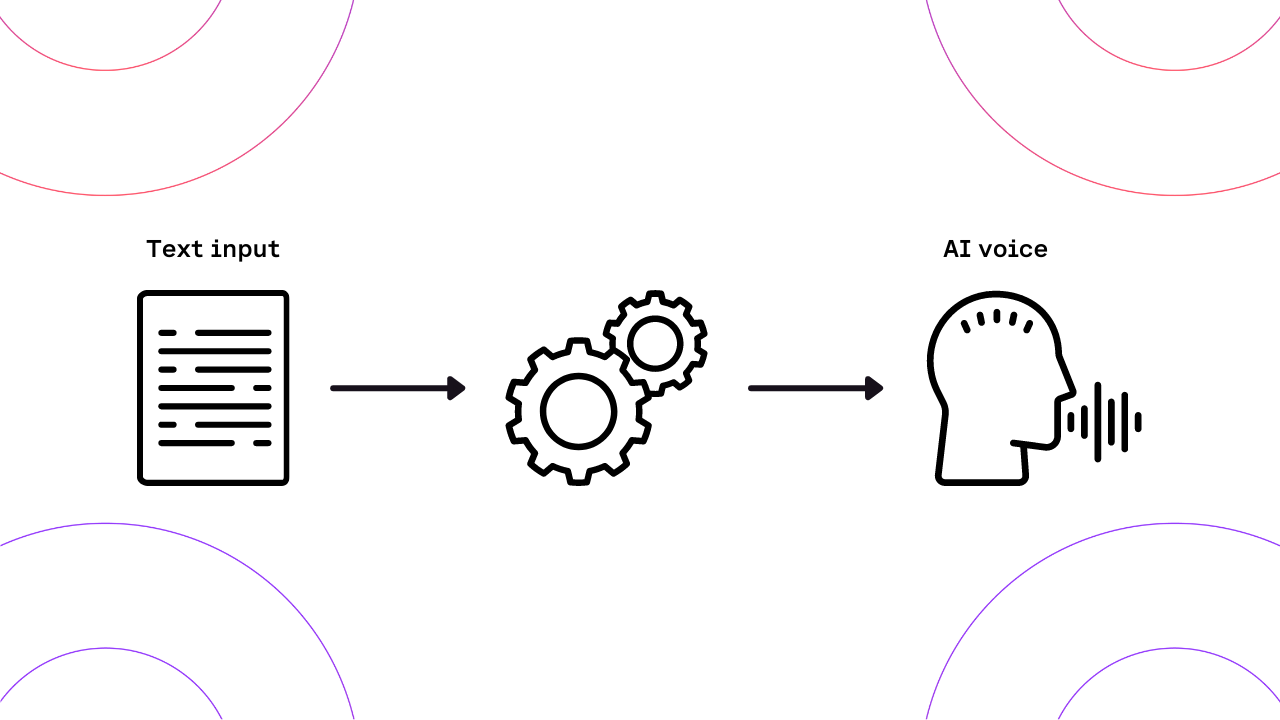
Our generative AI-powered text-to-speech solution addresses the identified challenges by offering a sophisticated platform that transforms text into highly natural and emotionally rich spoken audio. Key features of our solution include:
- Human-like Voice Synthesis: Leveraging advanced neural networks and deep learning models, our system generates speech that closely mimics human intonation, rhythm, and pronunciation, significantly reducing the ‘robotic’ sound often associated with traditional TTS.
- Emotional Intelligence: The solution incorporates a sophisticated emotion recognition engine that analyzes the sentiment of the input text. This allows the AI to dynamically adjust the voice’s tone, pitch, and speaking style to convey appropriate emotions, such as empathy, excitement, or urgency, making interactions more engaging and relatable.
- Voice Customization and Branding: Clients can choose from a diverse library of pre-trained voices or work with us to create a unique brand voice. This includes fine-tuning parameters like accent, gender, age, and speaking pace, ensuring consistency with brand identity across all voice interactions.
- Multi-lingual and Multi-accent Support: Our solution supports a wide range of languages and regional accents, enabling businesses to cater to a global audience with localized and culturally appropriate voice content. This is crucial for international customer support, e-learning, and content distribution.
- Real-time Processing and Scalability: Engineered for high performance, the system can convert large volumes of text to speech in real-time, making it suitable for dynamic applications like live customer service calls, interactive voice response (IVR) systems, and real-time content generation. Its scalable architecture ensures consistent performance even during peak demand.
- Seamless API Integration: We provide a well-documented and easy-to-use API that allows for straightforward integration into existing applications and workflows. This includes web applications, mobile apps, content management systems, and enterprise software, minimizing development overhead for clients.
- Content Creation Efficiency: By automating the voiceover process with high-quality, natural-sounding voices, our solution drastically reduces the time and cost associated with producing audio content for e-learning modules, audiobooks, podcasts, marketing campaigns, and accessibility features.
- Ethical and Responsible AI: We prioritize ethical AI development, implementing robust measures to prevent misuse of voice synthesis technology. This includes watermarking generated audio and providing tools for content authentication, addressing concerns related to deepfakes and ensuring responsible deployment.
Technical Architecture
Our generative AI text-to-speech solution is built upon a robust and scalable technology stack, designed for high performance, flexibility, and ease of integration. The core components and technologies include:
- Machine Learning Frameworks:
- TensorFlow/PyTorch: Utilized for building and training deep neural networks, particularly for advanced generative models like WaveNet, Tacotron, and Transformer-based architectures, which are fundamental to natural-sounding speech synthesis.
- Cloud Infrastructure:
- Google Cloud Platform (GCP)/Amazon Web Services (AWS)/Microsoft Azure: Leveraging cloud-agnostic principles, the solution can be deployed on leading cloud providers for scalable compute resources (GPUs/TPUs), storage, and managed services. This ensures high availability, global reach, and elastic scalability to handle varying workloads.
- Programming Languages:
- Python: The primary language for AI/ML development, data processing, and API backend services, due to its extensive libraries and frameworks for machine learning.
- Node.js/Go (for API Gateway/Microservices): Used for building high-performance, low-latency API gateways and microservices that handle requests and orchestrate interactions between different components of the TTS system.
- Database and Storage:
- NoSQL Databases (e.g., MongoDB, Cassandra): For storing large volumes of unstructured data, such as audio samples, voice models, and metadata, offering flexibility and scalability.
- Object Storage (e.g., Google Cloud Storage, AWS S3): For efficient and cost-effective storage of large audio datasets and generated speech files.
- Containerization and Orchestration:
- Docker: For packaging applications and their dependencies into portable containers, ensuring consistent deployment across different environments.
- Kubernetes: For orchestrating containerized applications, managing deployments, scaling, and ensuring high availability of the TTS services.
- API Management:
- RESTful APIs/gRPC: Providing well-defined interfaces for seamless integration with client applications, ensuring secure and efficient communication.
- Version Control and CI/CD:
- Git/GitHub/GitLab: For collaborative development, version control, and managing code repositories.
- Jenkins/GitHub Actions/GitLab CI/CD: For automated testing, building, and deployment pipelines, ensuring rapid and reliable delivery of updates and new features.
- Monitoring and Logging:
- Prometheus/Grafana: For real-time monitoring of system performance, resource utilization, and service health.
- ELK Stack (Elasticsearch, Logstash, Kibana): For centralized logging, analysis, and visualization of system logs, aiding in troubleshooting and performance optimization.
This robust technology environment ensures that our generative AI TTS solution is not only powerful and flexible but also maintainable, scalable, and secure, capable of meeting the demands of diverse enterprise applications.