The Challenge
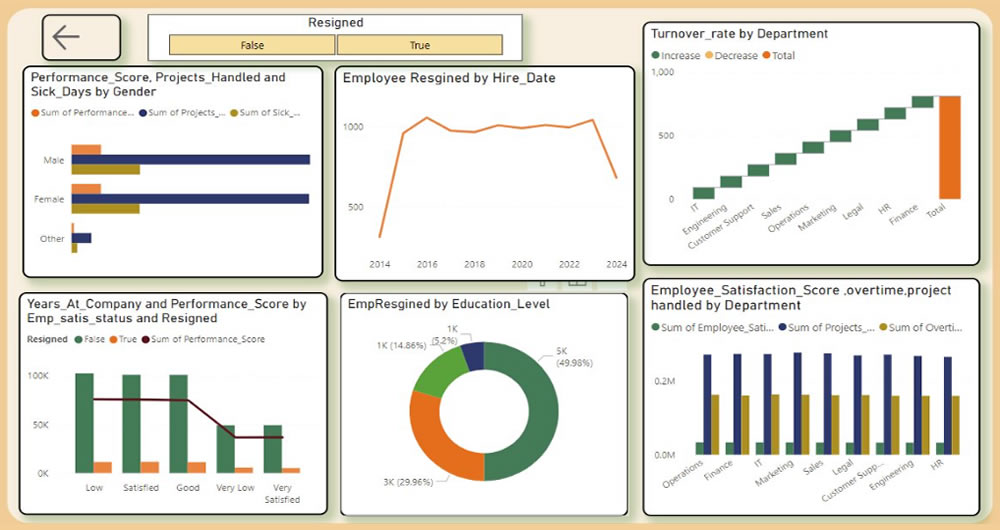
The organization was experiencing high employee attrition, with nearly 90% of employees leaving. Despite a moderate productivity score, low employee satisfaction was evident, particularly in certain departments. Promotion and training opportunities were inconsistent, leading to dissatisfaction, low motivation, and uneven performance. The absence of data-driven decision-making made it difficult to identify the root causes of these issues, such as burnout, dissatisfaction, or workload imbalance.
Scope of the Project
The project aimed to leverage HR analytics to:
- Reduce attrition and improve retention.
- Identify low-performing areas and underlying causes of dissatisfaction.
- Balance workloads and improve productivity.
- Create fairer promotion and recognition systems.
- Provide actionable insights to management for data-driven HR strategies.
The Solution
A comprehensive Power BI–based HR analytics dashboard was developed to provide actionable insights into workforce performance, satisfaction, and retention.
- Data Integration & Preparation: Employee data from multiple sources (Excel and internal HR systems) was collected, cleaned, and transformed. DAX functions were applied to calculate KPIs such as satisfaction scores, attrition rates, overtime hours, and promotion frequency.
- Workforce Insights: The dashboard provided department-level analysis of satisfaction scores, identifying areas with high dissatisfaction and turnover. These insights guided targeted retention programs, such as recognition initiatives and competitive promotions.
- Training & Development Monitoring: Gaps in training were identified, and standardized programs were recommended across departments to boost performance.
- Workload Balancing: Analysis of overtime and total work hours highlighted departments at risk of burnout. Workload was redistributed or additional hiring was suggested to balance productivity with well-being.
- Promotion & Recognition Fairness: Data revealed uneven promotion trends. Recommendations included implementing performance-based promotion policies to motivate employees and reduce dissatisfaction.
- Satisfaction Monitoring: Work-life balance and recognition initiatives were tracked, enabling HR teams to act quickly when scores declined.
This solution moved HR operations from reactive issue handling to proactive workforce management, making people strategy data-driven and measurable.
business Impact
- Reduced Attrition: Identification of key attrition drivers allowed the organization to design targeted interventions, improving employee retention.
- Improved Productivity: Balanced workloads and expanded training initiatives enhanced overall workforce efficiency.
- Higher Employee Satisfaction: Recognition programs, fair promotions, and proactive monitoring raised satisfaction scores.
- Cost Savings: Lower recruitment and training costs due to reduced turnover.
- Data-Driven HR: Management gained real-time visibility into employee metrics, enabling smarter decisions.
Technology Used
- Data Source: Excel and internal HR systems
- Data Preparation & Transformation: Power BI (DAX functions, data modeling)
- Visualization: Power BI dashboards for HR, leadership, and department managers
- Analytics: Attrition analysis, satisfaction trends, workload distribution, promotion monitoring