
The Challenge
The telecom company is struggling with high customer churn rates, where customers frequently switch to competitors by porting their SIM cards, leading to significant revenue loss and profitability challenges.
- Fragmented Data Sources
- Lack of Predictive Insights
- Ineffective Retention Campaigns
- Delayed Decision-Making
- High Customer Acquisition Costs
- Customer Dissatisfaction
Scope Of Project
- Identify high-risk customers through Data analytics.
- Centralized Data Integration.
- Customer Segmentation for Personalized Campaigns.
- Monitor churn trends in real-time dashboards.
- Proactive Alerts and Automation
Business Problem
The telecom company faced high customer churn rates, leading to revenue loss and increased operational costs
The Solution
Implementing a churn analytics solution using Power BI to address the challenges.
- Predictive Analytics for Churn Prediction:
- Forecast models were developed to identify high-risk customers based on usage patterns, complaints, and payment behavior.
- Customer Segmentation:
- Customers were grouped by demographics, service usage, and preferences, enabling targeted retention efforts.
- Personalized Retention Campaigns:
- Tailored offers, service upgrades, and promotions were deployed to at-risk customers, enhancing engagement and reducing churn.
- Proactive Decision-Making:
- Automated alerts were set up for key stakeholders, ensuring timely actions to retain customers before they churn.
Implementation
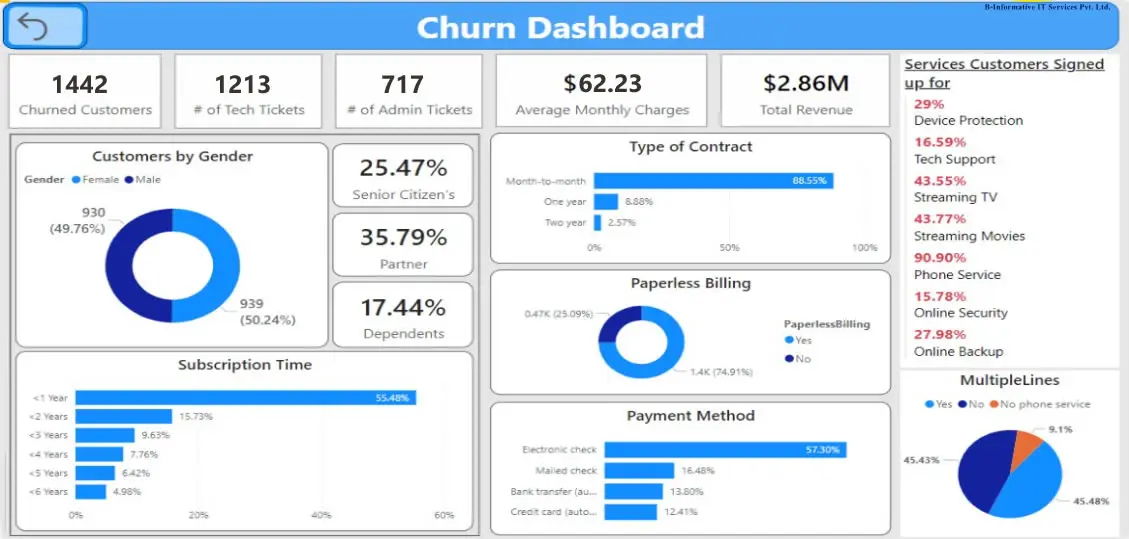
- Began by analyzing Telecom customer dataset that included key features like customer demographics, tenure, services signed up for, and churn status.
- Using Power BI, I cleaned the data and created relevant calculated columns and measures to capture customer behaviors such as service utilization, and tenure metrics.
- Key performance indicators like average tenure, churn risk percentage, customer retention rates, and service usage were
presented in Power BI dashboards.
Business Impact
- The solution provided a clear understanding of individual customer churn risks based on historical data, service usage,
and demographics. - The interactive Power BI dashboard allowed stakeholders to drill down into specific customer segments and evaluate the
effectiveness of different services and contracts. - The integration of metrics like churn risk and tenure allowed for the automation of identifying at-risk customers, enabling
proactive outreach and support. - This helped improve resource allocation and customer engagement strategies, resulting in reduced churn and higher
retention rates.
Technology USED
- Power query, Power Bi , SQL Server